…
Climate
Wildfires near Madrid: 25,000 hectares burned, air quality alert issued
Herz — Climate Desk · · 30s summary · 3 min read
The essentials
Massive wildfires across Madrid's Sierra Oeste and Ávila province have burned more than 25,000 hectares, forcing 80,000 people to evacuate or shelter in place. On July 25, 2026, Madrid's city authorities issued an air quality alert due to degraded conditions marked by orange haze and persistent smoke odor. By noon, 12 of the city's 14 monitoring stations reported 'fair' or 'poor' air quality levels. Spain's Health Minister Mónica García urged residents to stay indoors and wear FFP2 protective masks for any essential outdoor trips.
- More than 25,000 hectares burned in Madrid's Sierra Oeste and Ávila province
- 80,000 people evacuated or sheltering in place due to wildfires
- Madrid under air quality alert: orange haze and persistent smoke smell
- 12 of 14 monitoring stations showing degraded levels at noon on July 25, 2026
- FFP2 masks recommended outdoors; vulnerable people advised to stay inside
What we know
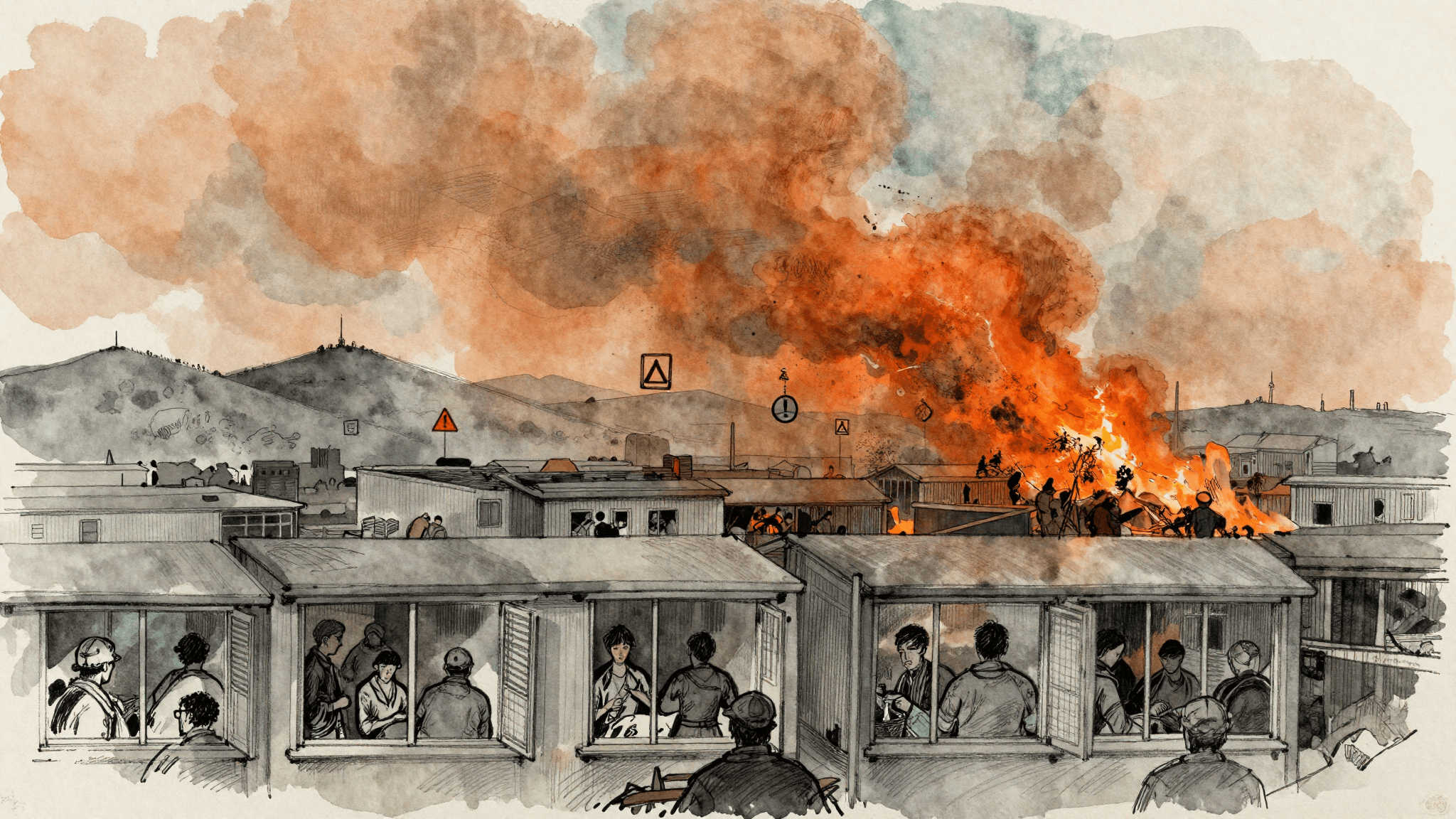
Massive wildfires are ravaging Madrid's Sierra Oeste and part of Ávila province. According to El País, more than 25,000 hectares have burned and 80,000 people are evacuating or sheltering in place.
On July 25, 2026, Madrid's city authorities issued an alert for an 'episode of air quality deterioration.' Concentrations of fine particles—PM2.5 and PM10, which are solid particles suspended in air—and other pollutants from wildfire smoke rose sharply. An orange haze and persistent smoke smell are visible and noticeable throughout the capital.
Threshold exceedances began to be detected starting at 11 p.m. Friday evening. By noon on July 25, 12 of the city's 14 monitoring stations reported 'fair' or 'poor' air quality.
The Collado Villalba monitoring station, west of the Madrid region and near the affected areas, reached PM2.5 levels overnight classified as 'highly unfavorable' and 'extremely unfavorable.' Comparable levels were recorded in Pozuelo, Alcobendas, and Algete.
The numbers
> 25,000 ha
Surface burned in Sierra Oeste and Ávila province
80,000
People evacuated or sheltering in place
12 / 14
Monitoring stations in Madrid showing degraded levels at noon on July 25
Health recommendations
Spain's Health Minister Mónica García stated that PM2.5 values are 'well above' World Health Organization (WHO) recommendations. She called on the public to remain indoors, wear FFP2 masks—single-use filtering masks that retain 94% of airborne particles under European standards EN 143 and EN 149—and protective eyewear if going outside.
PM2.5 values are well above WHO recommendations.
— Mónica García, Spain's Health Minister
Authorities recommend keeping doors and windows shut, setting air conditioning to 'recirculation' mode to avoid outside air, avoiding outdoor sports or physical activity in affected areas, and staying well hydrated.
Dr. Juan Torres, head of internal medicine at Hospital Infanta Leonor de Vallecas in Madrid, clarifies that standard surgical masks do not protect against smoke. FFP2 or FFP3 masks are recommended, especially for vulnerable populations: elderly people, those with chronic heart or respiratory conditions, pregnant women, and young children.
Topics
Related articles
Latest articles
The illustrations in this article are generated by artificial intelligence.
Comments
No comments yet. Be the first to react.