…
World
Nepal: Water Reservoir Threatens to Burst After Glacier Collapse
Herz — World Desk · · 30s summary · 3 min read
The essentials
Nepal issued an alert Friday about the risk of rupture of a vast water reservoir formed in Chinese Tibet following a glacier collapse that occurred two days earlier. The disaster triggered a flood and landslides. Death toll estimates vary significantly, ranging from at least 163 to 579 deaths and 1,400 to nearly 2,000 missing persons. In Nepal, 104 people have been rescued, but mud and blocked roads are hampering relief efforts. Scientists warn of similar risks in mountainous regions worldwide, including the Alps.
- A vast water reservoir threatens to rupture in Chinese Tibet
- Glacier collapse triggered a flood and landslides
- Death toll estimates vary widely between sources
- Rescue teams saved 104 people in Nepal
- Swiss village of Randa established safety perimeters
What We Know
Nepal issued an alert Friday about the risk of rupture of a vast water reservoir in Chinese Tibet, according to France 24 and AFP reports. The reservoir formed after part of a glacier collapsed two days earlier.
The United States Geological Survey (USGS), an American government agency devoted to Earth sciences, attributes the flood to this glacier collapse. The force was recorded as a 5.2 magnitude earthquake and triggered numerous landslides.
A previous article from Lost in the Jungle describes an avalanche of ice and debris followed by a surge of floodwater. The two publications, however, report different casualty figures.
Rescue operations saved 104 people in Nepal. Mud and blocked roads are hindering access to the border zone and ongoing relief efforts.
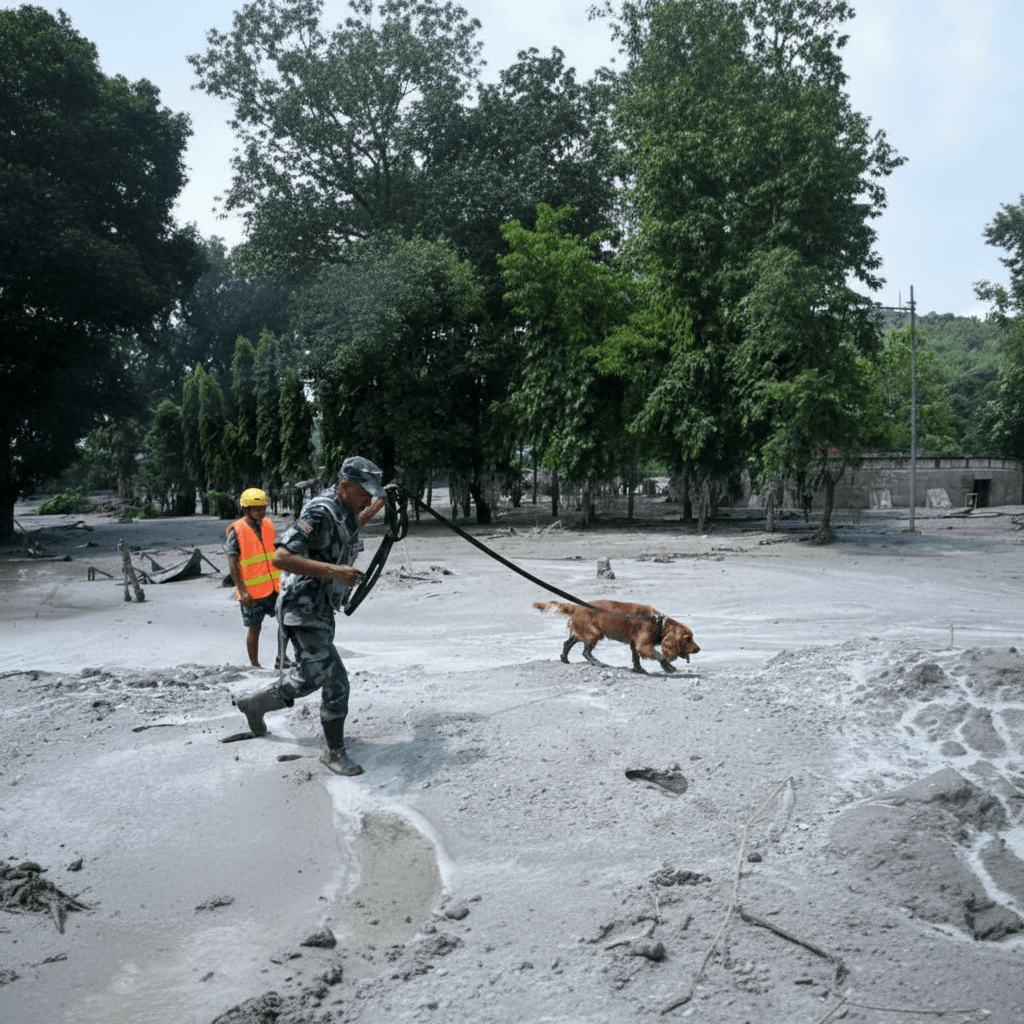
On August 27, 2026, security personnel and search dogs were combing the area around Trishuli in Nepal's Nuwakot district.
Risk of Further Collapse
Researcher Simon Cox believes that the removal of a section of the mountain may have destabilized neighboring materials. Another collapse could occur immediately in the original area.
Glaciologist Étienne Berthier does not rule out a comparable phenomenon elsewhere. However, he believes that the terrain and tectonic activity of the Himalayas increase the likelihood of an event of this magnitude.
Alaska also has dynamic glaciers, he notes. However, comparable phenomena occur there in completely uninhabited regions.
Similar Phenomena Observed in Switzerland
Tristram Hales, an environmental risk specialist at Cardiff University, has observed over the past decade a surge in extremely dangerous flows. He cites the Himalayas and Switzerland as examples.
Scientists regard rockfalls and landslides as more likely than the collapse of an entire mountainside. Earthquakes or permafrost melt accelerated by climate change can trigger them.
Risks to populations increase when urbanized areas, roads, or tourist facilities are located near exposed zones.
Geomorphologist Ludovic Ravanel reports a record number of rockfalls during the record-hot summer in the Alps. Some were fatal, and according to him, the vast majority are attributable to the climate crisis.
In Randa, Switzerland, the community of about 400 residents fears glacier collapse in the coming days. It has established safety perimeters following several rockfalls.
A Disaster Difficult to Predict
Étienne Berthier judges the Himalayan disaster to have very low predictability. Analysis of rock movements will need to determine whether weaknesses were visible in the preceding weeks or months.
The formation of glacial lakes poses a more visible risk. These lakes can experience rapid draining, called a GLOF (glacial lake outburst flood), when a natural ice dam breaks and suddenly releases the water.
Topics
Source
Related articles



Latest articles



The illustrations in this article are generated by artificial intelligence.
Comments
No comments yet. Be the first to react.