…
…
World
Herz — World Desk · · 30s summary · 4 min read
The Gironde megafire, which started in Saumos on July 22, 2026, was declared 'contained' on the evening of July 31 after nine days of fighting and 42,000 hectares devastated — France's worst fire since 1949. About 198,000 of the evacuated people, or 90%, were able to return home, but four municipalities remain completely evacuated. Two firefighters died, 267 were injured, and 240 homes were destroyed. Meanwhile, a fire declared under control in the Gros Bessillon massif (Var) reignited in mistral winds, burning 1,000 additional hectares in six hours.
The Gironde megafire, which started in Saumos on July 22, 2026, was declared 'contained' on the evening of July 31 after nine days of fighting and 42,000 hectares devastated, according to Le Temps. It is not yet 'fixed' and represents the most devastating fire in France since 1949.
By the evening of July 31, 198,000 people — or 90% of those evacuated — were able to return home or were about to do so. The reception center at the Bordeaux exhibition grounds closed that evening.
Four municipalities remain completely evacuated: Saumos, Le Temple, Le Porge, and Lège-Cap-Ferret. Two hundred forty kilometers of fire perimeters still need treatment, mainly in Le Porge and south of Lacanau.
Two firefighters died in Mérignac during a fire that occurred the day before the megafire began. A minute of silence was held for them on the morning of July 31 in Gironde's fire stations.
The megafire destroyed 240 homes — a preliminary count. Two hundred sixty-seven firefighters were injured during the firefighting effort.
Allain Bougrain-Dubourg, president of France's bird protection league (LPO), said on radio station RMC that wildlife had been affected 'by the millions' by the fires in France.
The firefighting effort mobilized 3,300 firefighters from across France, 1,500 military personnel, and 1,250 police and gendarmes. Twenty-four aerial resources were deployed, including seven provided by the European Union.
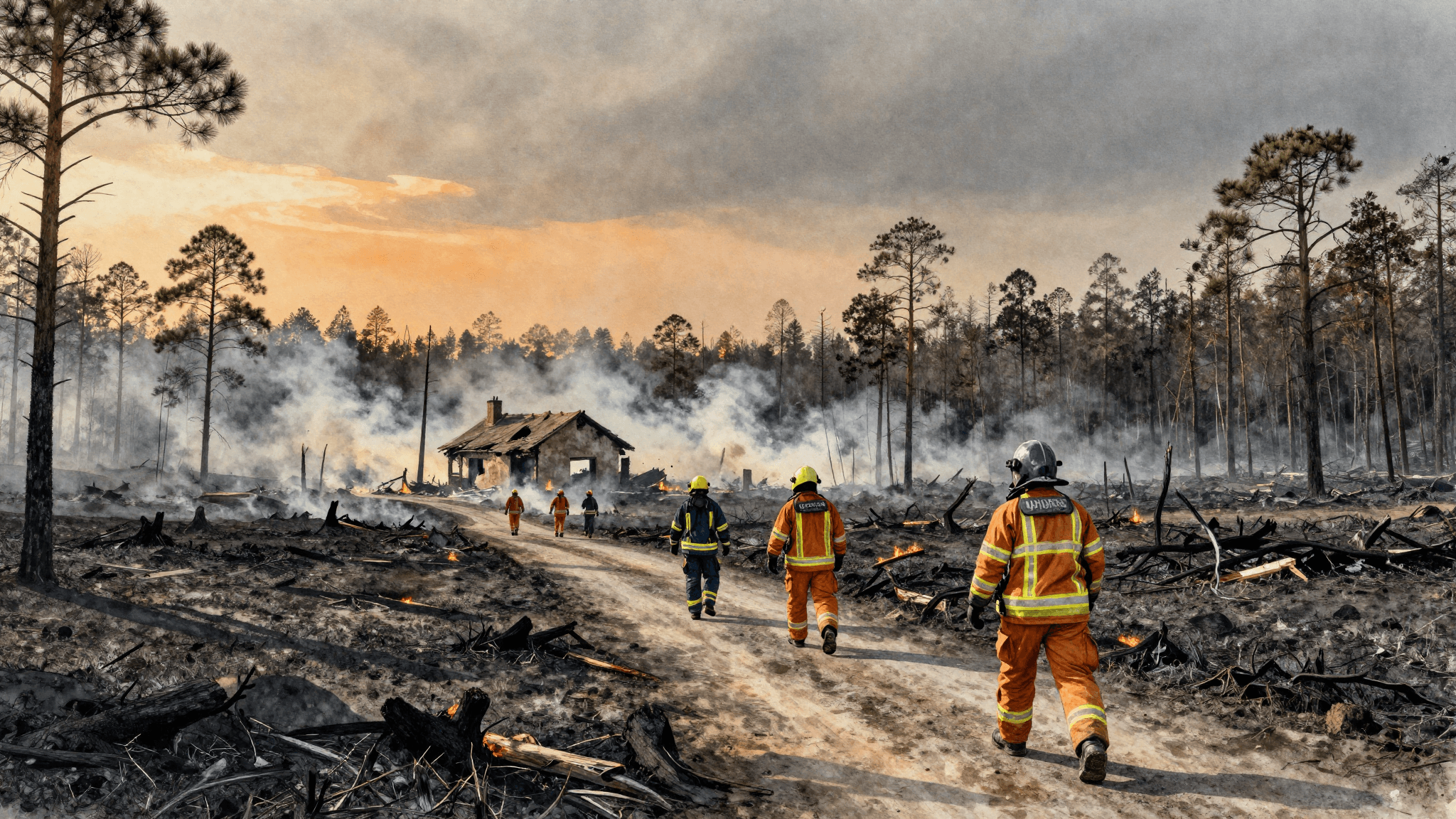
The illustrations in this article are generated by artificial intelligence.
No comments yet. Be the first to react.
Bordeaux's Departmental Operations Center managed the crisis around the clock for nine days. Forestry and perimeter treatment operations were scheduled to begin on the morning of July 31.
Railway traffic interrupted on July 26 south of Bordeaux is expected to resume on Saturday, August 1, 2026. According to France's Finance Ministry, a quarter of the 82,000 workers affected by evacuations had already returned to work by Thursday, July 30.
The fire in the Gros Bessillon massif (Var), which had burned 4,500 hectares and was declared contained, reignited on July 31 around 1:30 p.m. under the effects of mistral wind gusts, burning an additional 1,000 hectares in six hours.
Approximately 2,500 residents were evacuated, particularly in Correns and Montfort-sur-Argens. Five hundred firefighters are deployed on the ground, supported by 6 water-bombing helicopters, 6 Canadair aircraft, and 2 Dash turboprop planes.
Across France, 308 arrests have been made in investigations into fire origins. Two-thirds of these cases are suspected to be deliberate, with 33 detentions. However, the largest fires of the season are believed to be accidental based on initial investigation findings.
In Upper Corsica, after 18 days of mobilization, the situation is under control in the Restonica Valley, a popular tourist destination. More than 1,000 hectares were devastated in the area.
Swiss firefighters were deployed to Gironde to support French services, with a second contingent from French-speaking Switzerland taking over. The A63 motorway has been reopened, and 9 municipalities have been able to reintegrate following the fire's stabilization.
In Switzerland, 98.6% of the 74,318 firefighters are volunteers, organized under a militia system — a principle of organization specific to Swiss public life. This model is facing pressure from the increasing number of natural disasters linked to climate change, particularly regarding employer availability for volunteers.
The total number of people evacuated in Gironde varies between sources: Le Temps reports 220,000, while an earlier Lost in the Jungle article mentioned 224,000. A definitive figure has not yet been established.
The count of 240 homes destroyed is preliminary; it will be consolidated during subsequent assessments of the affected areas.
No. As of July 31, 2026, it is declared 'contained' but not yet 'fixed'. Two hundred forty kilometers of fire perimeters remain to be treated, and four municipalities remain completely evacuated.
The total figure is uncertain depending on the source: 220,000 according to Le Temps, 224,000 according to an earlier Lost in the Jungle article. In either case, approximately 198,000 people (90%) were able to return home by the evening of July 31.
3,300 firefighters (with 267 injured), 1,500 military personnel, 1,250 police and gendarmes, and 24 aerial resources including 7 provided by the European Union were deployed.
The Gros Bessillon fire, declared contained after burning 4,500 hectares, reignited on July 31 around 1:30 p.m. in mistral winds. It has burned an additional 1,000 hectares in six hours. Approximately 2,500 people have been evacuated.
Yes. A first contingent and then a second contingent from French-speaking Switzerland were deployed to Gironde. Switzerland has 74,318 firefighters, of which 98.6% are volunteers organized under a militia system — a principle unique to Swiss public life.