…
Tech & Science
Puberty and Identity: Study on Conversations Between Black Mothers and Daughters
Herz — Tech & Science Desk · · 30s summary · 2 min read
The essentials
A qualitative study from the University of Michigan, published in the Journal of Research on Adolescence — a quarterly peer-reviewed academic journal specializing in adolescence — examines how conversations between Black mothers and daughters evolve during puberty. For these young girls, puberty represents a dual transition: biological and identity-based. Mothers help their daughters name and interpret bodily changes, gender expectations, and racialized messages. Rona Carter, associate professor of psychology at the University of Michigan, is the principal researcher.
- Puberty is an identity transition for Black girls, not solely a biological one, according to the study
- Mothers guide daughters through body changes, gender norms, and racialized messages
- As girls approach late puberty, they increasingly assert their own interpretations
- Mother-daughter disagreements contribute to healthy identity development
- The study focuses exclusively on Black mother-daughter dyads without interracial comparison
What We Know
A team at the University of Michigan published a qualitative study in the Journal of Research on Adolescence — a quarterly academic journal founded in 1991, published by Wiley-Blackwell for the Society for Research on Adolescence and specializing in research on adolescent development (DOI: 10.1111/jora.70226). The principal researcher is Rona Carter, associate professor of psychology.
The study examined Black mother-daughter dyads — pairs, meaning two-person units. It is qualitative in nature and establishes no direct comparison with other racial groups or family structures.
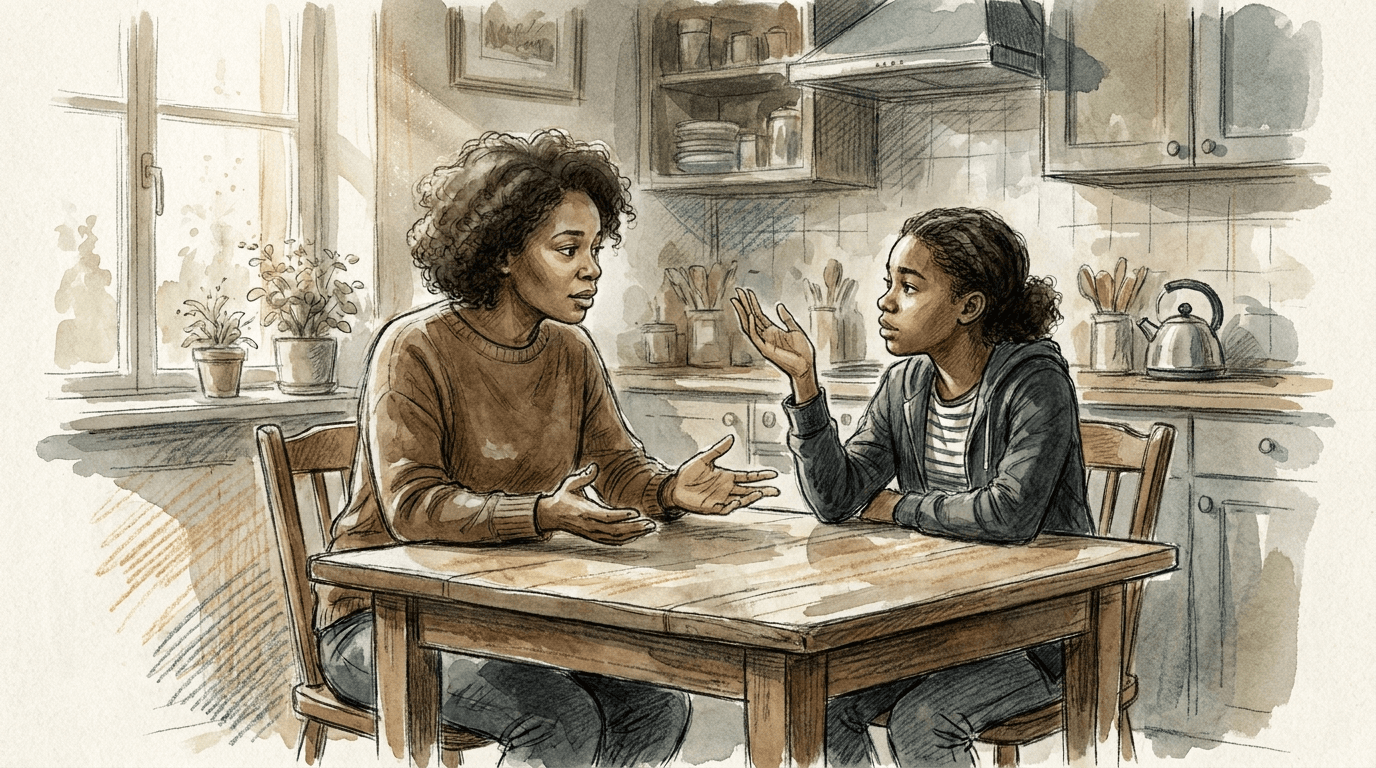
First finding: for Black girls, puberty is not only a biological transition but also an identity transition. Conversations with their mothers become a space to make sense of bodily changes, gender, race, ethnicity, and social expectations.
Second finding: mothers practice scaffolding — helping their daughters name, interpret, and organize their experiences with bodily changes, gender expectations, racialized messages, and social comparison.
Third finding: early in puberty, mothers play a more directive role. As puberty progresses, daughters increasingly assert their own interpretations, indicating a shift toward more active identity negotiation.
Puberty can intensify identity conversations for Black girls, with mothers helping their daughters make sense of gender, race, ethnicity, and bodily changes.
— Rona Carter, Associate Professor of Psychology, University of Michigan
Disagreements as Moments of Identity Building
Fourth finding: disagreements between mothers and daughters are not mere communication problems. The study analyzes them as moments when both parties negotiate, revise, and repair identity meanings together, contributing to healthy identity development.
What Remains Uncertain
The study is limited to Black mother-daughter dyads; its conclusions cannot be generalized to other racial groups, family structures, or cultural contexts. The qualitative nature of the research also restricts its statistical reach. Additionally, the term "scaffolding" is used here in the sense of developmental psychology; no verified definition covering this specific usage was available.
Frequently Asked Questions
What is the Journal of Research on Adolescence?
It is a quarterly academic journal founded in 1991 and published by Wiley-Blackwell for the Society for Research on Adolescence. The journal publishes quantitative and qualitative research on the cognitive, physical, emotional, and social development of adolescents.
Related articles


Latest articles
The illustrations in this article are generated by artificial intelligence.
Comments
No comments yet. Be the first to react.