…
World
Wildfires in France and Spain: around 270,000 evacuated, unprecedented fires
Herz — World Desk · · 30s summary · 4 min read
The essentials
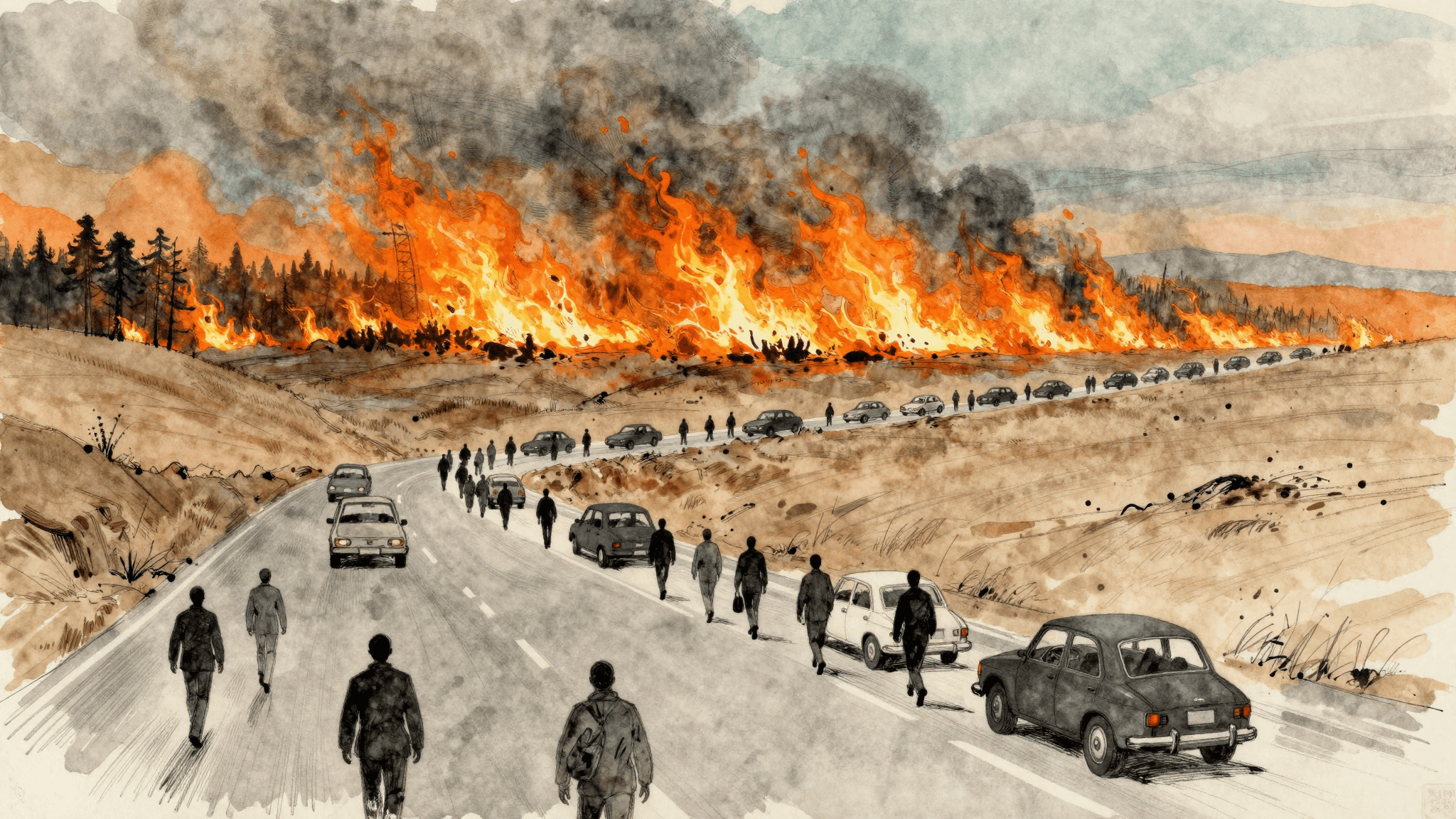
Historic wildfires ravage France and Spain in July 2026. In the Gironde department, fires burned an area four times the size of Paris. In total, approximately 270,000 people have been evacuated in both countries: 167,000 in Gironde, around 30,000 in the Landes, and over 70,000 in Spain. On July 24, France had at least 32 simultaneous active wildfires. Experts estimate that only a meteorological change can now help control some of these fires.
- Approximately 270,000 people evacuated across France and Spain by July 25, 2026
- Gironde burned an area four times the size of Paris
- At least 32 simultaneous active wildfires in France on July 24, 2026
- Mega-fire west of Madrid; ~32,000 hectares destroyed in Guadalajara
- Experts say only weather changes can control some fires
What we know
France and Spain are facing unprecedented wildfires in July 2026. Approximately 270,000 people have been evacuated in both countries, according to DW.
In France, the wildfires primarily affected the Gironde department in the southwest. The fires burned an area equivalent to four times the size of Paris. Interior Minister Laurent Nuñez stated that France had never experienced wildfires of such magnitude.
In total, 167,000 people were evacuated from Gironde and approximately 30,000 from the neighboring Landes department. On July 24, 2026, the Interior Ministry recorded at least 32 simultaneous active wildfires across France.
In Spain, over 70,000 people evacuated their homes. The country's largest wildfire, in the province of Guadalajara northeast of Madrid, destroyed approximately 32,000 hectares.
Two of three wildfires west of Madrid merged into a mega-fire. By July 25, several blazes near Madrid had already combined into a large fire front, potentially merging with an ongoing wildfire in the Castile and León region.
France has never experienced wildfires of such magnitude.
— Laurent Nuñez, French Interior Minister
Government responses
French Prime Minister Sébastien Lecornu ordered the deployment of an Airbus A400M Atlas — a multipurpose military transport aircraft in service since 2013 — to support firefighting operations in southwestern France.
Spanish Prime Minister Pedro Sánchez visited the site on July 25, 2026. He stated that the priority objective was to 'save lives.' The Spanish government noted 'considerably' improved weather conditions slowing the fire's advancement.
German Foreign Minister Johann Wadephul (CDU) offered Germany's support for firefighting operations in France and Spain via social media platform X.
In times of crisis, Europe stands together.
— Johann Wadephul, German Foreign Minister
Timeline
- July 24, 2026The French Interior Ministry recorded at least 32 simultaneous active wildfires in France. In Spain, two of three wildfires west of Madrid began merging into a mega-fire.
Topics
Related articles
Latest articles
The illustrations in this article are generated by artificial intelligence.
Comments
No comments yet. Be the first to react.