…
World
TSMC Develops COUPE, an Optical Technology to Transform Data Centers
Herz — World Desk · · 30s summary · 2 min read
The essentials
TSMC, the world's largest chipmaker based in Taiwan, is developing COUPE (Compact Universal Photonic Engine), a technology that transmits data via light instead of copper, according to Handelsblatt. This approach promises faster transfers and lower energy losses in data centers. Its adoption faces resistance from Nvidia, TSMC's key client. The initiative reflects a context where chip miniaturization is reaching its physical limits, pushing the industry to rethink how chips cooperate with each other.
- TSMC is developing COUPE, which transmits data via light rather than copper
- The technology promises faster speeds and reduced power consumption
- Nvidia, TSMC's key client, is slowing adoption of this optical innovation
- Chip miniaturization is hitting physical limits and becoming increasingly costly
- Industry now measures progress by chip cooperation, not just nanometers
What We Know
TSMC, the world's largest chipmaker based in Taiwan, is developing a new connection technology called COUPE — for Compact Universal Photonic Engine — designed to transform data centers, according to Handelsblatt on July 25, 2026.
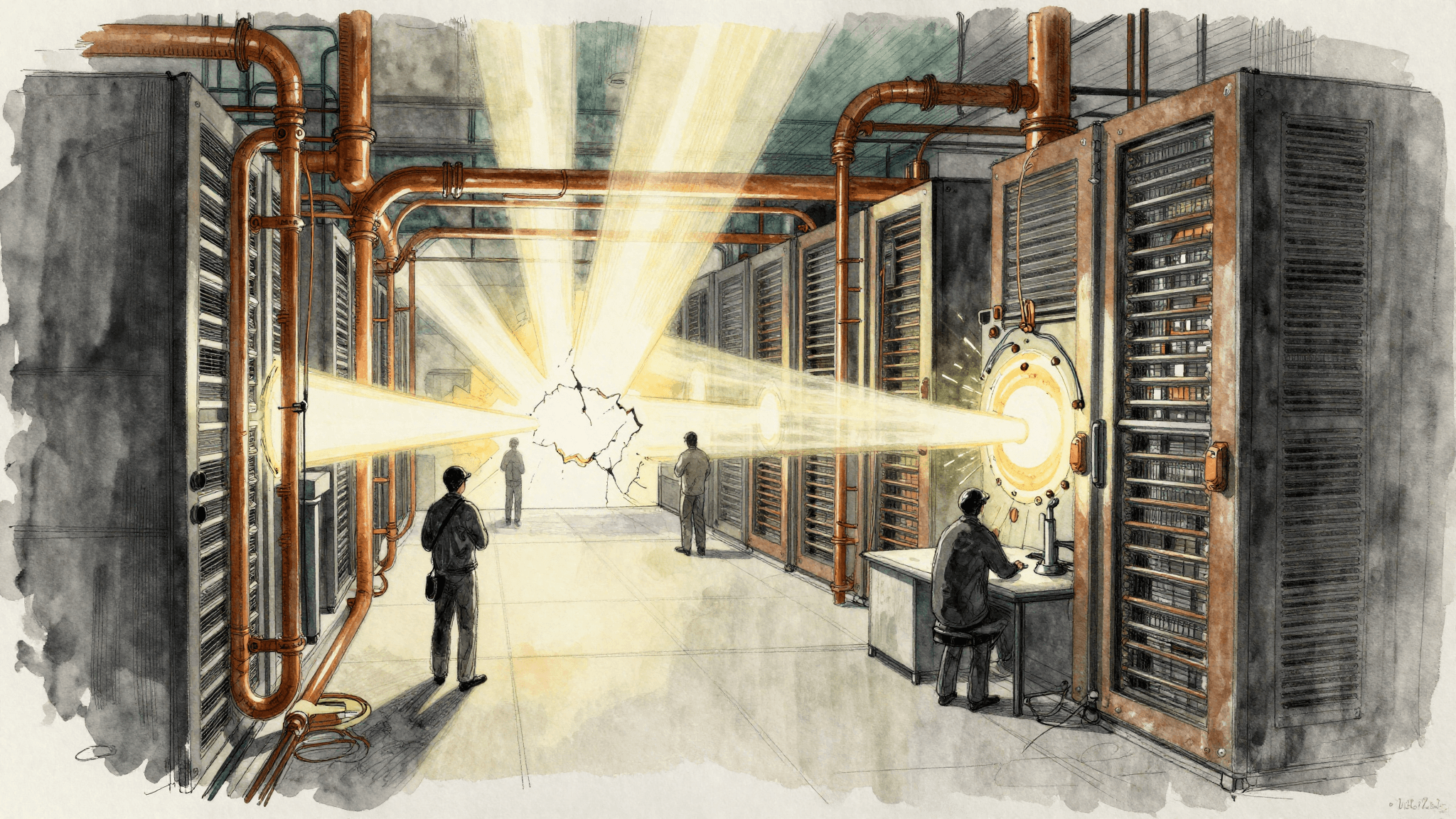
COUPE's principle is to transmit data no longer via copper wires, but via light. This method promises superior transfer speeds and reduced energy losses.
Nvidia's Resistance
Nvidia, TSMC's key client led by CEO Jensen Huang, is currently slowing the adoption of this optical technology. This setback illustrates the difficulty of the transition across the entire industry.
Context: The Limits of Miniaturization
Modern chips now integrate hundreds of billions of transistors. Yet miniaturization — the reduction in size of these components — is becoming increasingly costly, complex, and facing physical limits.
The semiconductor industry is thus entering a new phase. Progress is no longer measured solely in nanometers, but in how chips cooperate with each other. C.C. Wei, TSMC's CEO, is steering this strategy.
What Remains Uncertain
No deployment timeline for COUPE is currently available. The exact reasons why Nvidia is slowing adoption of this technology are not detailed in the available sources. The official technical definition of COUPE has not been independently verified.
What is TSMC's COUPE technology?
COUPE (Compact Universal Photonic Engine) is a connection technology that transmits data via light rather than copper. It aims to accelerate transfers and reduce energy losses in data centers.
Why switch from copper to light for data transmission?
Light transmission offers two key advantages: superior speed and reduced energy losses. These are important considerations for modern data centers.
Why is Nvidia slowing COUPE adoption?
Available information indicates that Nvidia, through CEO Jensen Huang, is slowing adoption of this optical technology. The exact reasons are not detailed in current sources.
Why is the chip industry changing its approach?
Chip miniaturization is hitting physical limits and becoming increasingly costly. The industry is therefore exploring new ways to progress, notably by improving communication between chips rather than miniaturizing them further.
Topics
Related articles
Latest articles
The illustrations in this article are generated by artificial intelligence.
Comments
No comments yet. Be the first to react.