…
World
An interwar collective built machines intended to communicate with the dead
Herz — World Desk · · 30s summary · 3 min read
The essentials
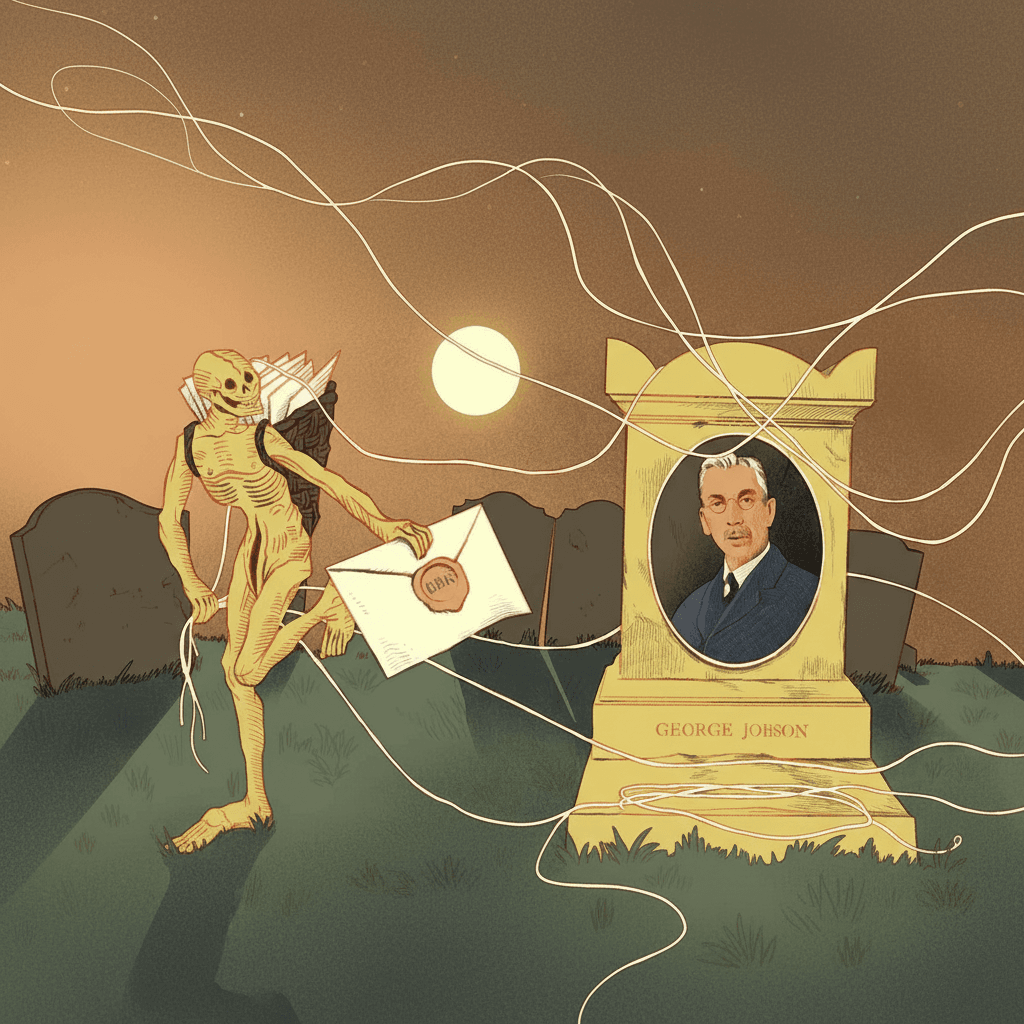
During the interwar period, the Ashkir-Jobson Trianion collective built several machines intended to enable communication with the dead, but no success has been established. The experiments were part of a succession of projects combining technology and spiritualism. Other devices claimed to weigh the soul, capture the voices of the deceased on magnetic tape or establish contact by radio. Thomas Edison also designed the necrophone, which never produced results. In 1982, George Meek and William O’Neil proposed the Spiricom in the United States, using frequencies between 30 and 130 MHz.
- The Ashkir-Jobson Trianion collective built several machines during the interwar period.
- No successful communication with the dead has been established.
- Other experiments used measuring devices, magnetic tape or radio.
- Thomas Edison designed a similar project, but it never produced results.
What is known
During the interwar period, the Ashkir-Jobson Trianion collective built a series of machines intended to enable communication with the dead. No success has been established, according to Le Temps.
Philippe Simon’s article about these devices was published on August 12, 2026, at 08:38 and updated at 08:39.
Devices intended to weigh the soul
Johannes Jacobus Zaalberg van Zelst, a Dutchman born in 1827 who died in 1903, contributed to the invention of two devices: the psychatomometer and the dynamistograph.
The machines were presented as capable of weighing the soul and demonstrating, without a medium, that it was material and quantifiable.
Two of Zaalberg van Zelst’s collaborators also set out their theory in “Het Geheim van den Dood.” A French translation appeared in 1912 under the title “Le Mystère de la mort.”
They claimed that the soul consisted of matter that was extremely fine but very heavy, and that it occupied the molecular spaces within a living organism.
The influence of new technologies
Around the turn of the 20th century, technological development, particularly electrification, encouraged the proliferation of devices claiming to contact the dead.
These experiments emerged while spiritualism and the Ouija board were popular.
Thomas Edison, inventor of the phonograph, designed the necrophone, a proposed device intended to capture the speech of the dead. The experiment never came to fruition.
Philippe Simon published an earlier article about Edison’s project on August 10, 2026. It was part of a series examining technology as a means of communicating with the dead.
From magnetic tape to radio
Jürgenson and Raudive made magnetic-tape recordings as part of attempts to communicate with the dead.
In 1982, George Meek and William O’Neil proposed another device in the United States: the Spiricom, which was based on a transmitter-receiver.
Meek claimed that the device operated between 30 and 130 MHz. It was supposed to require an operator credited with so-called “bioplasmic” psychic abilities.
Timeline
- Around the turn of the 20th centuryElectrification accompanied the proliferation of devices claiming to communicate with the dead.
- 1912“Le Mystère de la mort,” the French translation of “Het Geheim van den Dood,” presented a theory about the soul’s material nature.
Topics
Source
Related articles
Latest articles
The illustrations in this article are generated by artificial intelligence.
Comments
No comments yet. Be the first to react.