…
World
Direct terminé
Live · Ceuta crossings trigger political offensive against Sánchez over Spain’s regularisation plan
Herz — World Desk · · · 30s summary · 3 min read
The essentials
Approximately 60,000 people crossed the Spanish-Moroccan border at Ceuta on Thursday, prompting European politicians to attack Pedro Sánchez's government and link the arrivals to Spain's regularisation process. Sánchez, present at the scene, characterized the influx as an « attack » on Spanish territorial integrity, which the enclave deems impossible to absorb given its population. Madrid rejects that connection, noting that recent arrivals cannot qualify because applicants must have lived in Spain before January 1, 2026, and show five months of continuous presence. Italian Foreign Minister Antonio Tajani has called for the Schengen area to be closed with Spain. The European People's Party group wants the crisis placed on the European Parliament's agenda in September 2026.
- Tens of thousands crossed the Spanish-Moroccan border at Ceuta on Thursday.
- European politicians linked the crossings to Spain’s regularisation process.
- Madrid says recent arrivals do not meet the residency requirements.
- The EPP group wants a European Parliament debate in September 2026.
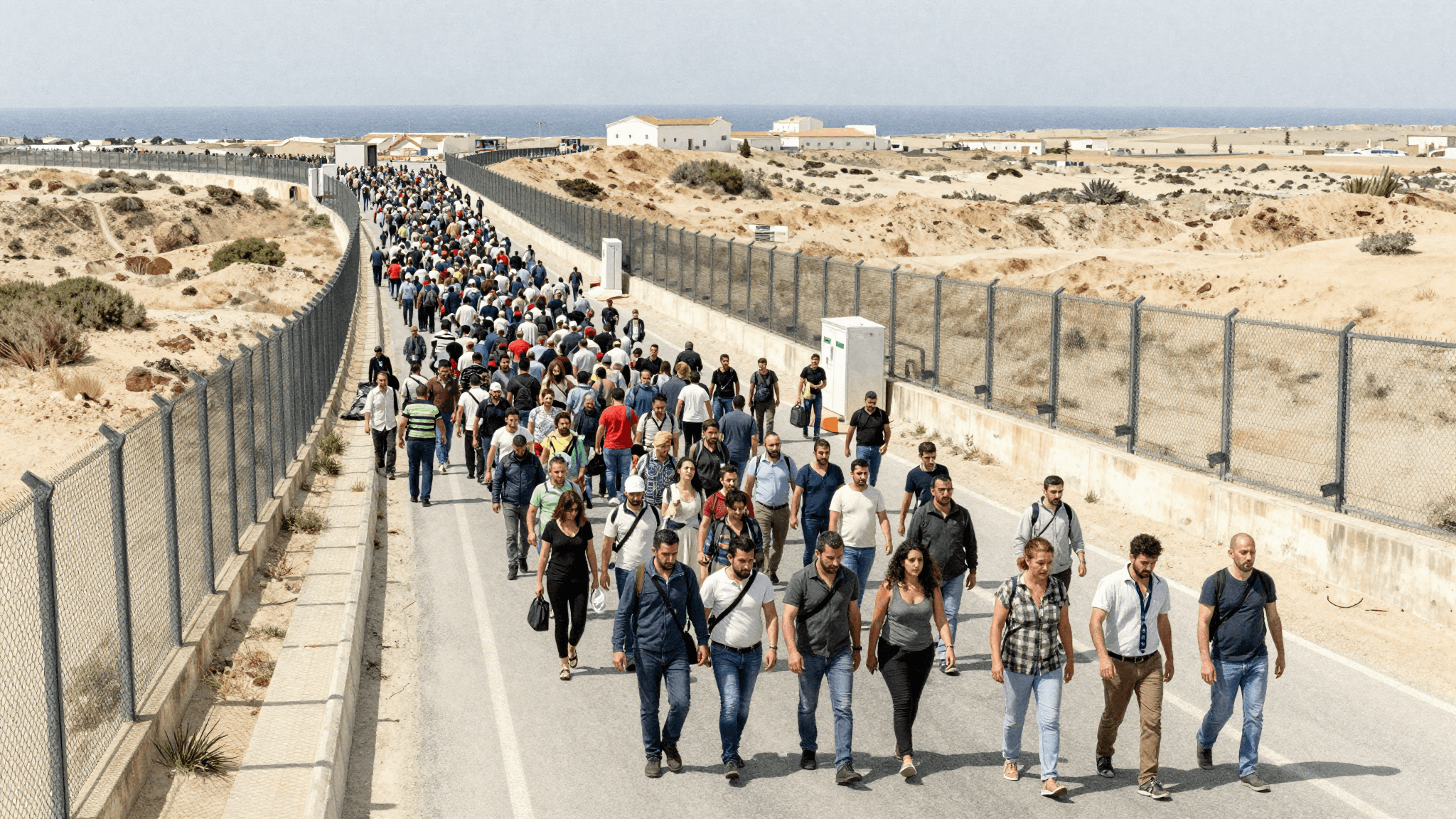
- 31.07 16:09Spanish Prime Minister Sánchez visited Ceuta and characterized the massive crossing (approximately 60,000) as an « attack » on Spanish territorial integrity. The enclave president stated it is impossible to absorb pressure representing approximately 70% of the population.
What is known
Tens of thousands of people crossed the Spanish-Moroccan border at Ceuta on Thursday, according to El País. The arrivals prompted an immediate political offensive against Pedro Sánchez’s government.
Manfred Weber, president of the European People’s Party and its group in the European Parliament, described the situation as “alarming” in a post on X. He linked the crossings to what he called the direct pull effect of Spain’s mass regularisation process.
François-Xavier Bellamy, a vice-president of the EPP group, said the process had already received more than one million applications. He cited that figure alongside the crossings at Ceuta.
Michel Barnier amplified Bellamy’s comments and said the European Union should be able to protect its borders immediately when, in his view, a member state creates an incentive for irregular migration.
Madrid rejects the alleged link
The Spanish government denies any connection between the Ceuta crossings and the regularisation process. It says people who arrived in recent days cannot benefit from the scheme.
Applicants must prove that they were resident in Spain before January 1, 2026, and that they had been continuously present for five months when submitting their application.
Calls to restrict Schengen travel with Spain
Italian Foreign Minister Antonio Tajani said he supported closing the Schengen area with Spain. He referred to more than 500,000 irregular immigrants and claimed that Madrid was granting them “Spanish, and therefore European, citizenship.”
The government of Italian Prime Minister Giorgia Meloni is also considering closing the Schengen area with Spain.
In February 2026, however, European Commissioner for Home Affairs Magnus Brunner told the EPP that a national residence permit allows its holder only to live and work in the member state that issued it, not to move freely throughout the EU.
That statement contradicts Tajani’s claim that people regularised in Spain would automatically gain freedom of movement across the European Union.
What happens next
The EPP group has proposed adding the Ceuta crisis to the agenda of the European Parliament’s first plenary session in September 2026.
In recent months, EPP lawmakers have voted with the Parliament’s three far-right political families to tighten the EU’s rules on returning foreign nationals.
Topics
Related articles
Latest articles
The illustrations in this article are generated by artificial intelligence.
Comments
No comments yet. Be the first to react.