…
World
Berlin's Treehouse at the Wall, symbol of Turkish immigration, faces demolition threat
Herz — World Desk · · 30s summary · 4 min read
The essentials
In Berlin's Kreuzberg district, the Treehouse at the Wall—a rundown two-storey structure built around an adult tree in the former Berlin Wall no man's land—faces demolition by municipal authorities. Built from 1983 by Osman Kalin, a Turkish worker who came as part of Germany's post-war Gastarbeiter (guest worker) program, this building has become a symbol of Turkish immigration. Since Kalin's death in 2018, his son Mehmet maintains it. Supporters are campaigning to have it designated a memorial to immigrant workers.
- The Treehouse at the Wall in Kreuzberg risks demolition by Berlin authorities for public safety reasons.
- Built in 1983 by Osman Kalin, a Turkish Gastarbeiter, in the Berlin Wall no man's land.
- About 14 million immigrants joined West Germany through the Gastarbeiter program (1955–1973).
- Advocates seek memorial status to honour post-war immigrant workers.
- Three million people of Turkish origin live in Germany today.
What we know
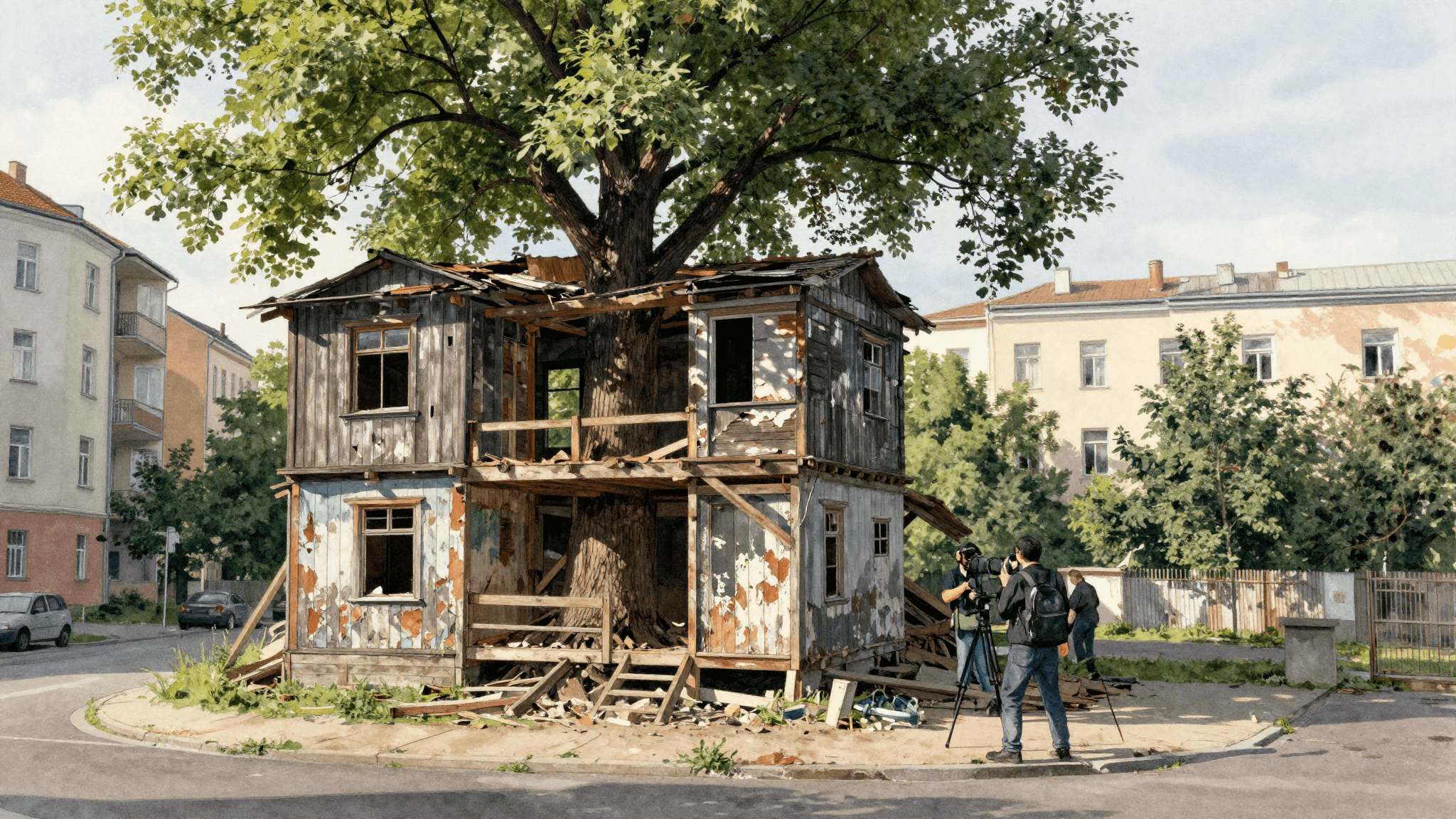
The Treehouse at the Wall (Baumhaus an der Mauer in German)—a rundown two-storey structure built around an adult tree trunk on a traffic island in Berlin's Kreuzberg district—faces demolition threats, according to The Guardian.
Berlin's municipal authorities could order its demolition on public safety grounds. Supporters are campaigning for it to be designated a memorial to post-war immigrant workers.
Osman Kalin, its builder, died in 2018 as a respected local figure in Kreuzberg. Since then, his son Mehmet has maintained the property and preserved his father's legacy.
symbol of resistance as well as a symbol against racism, discrimination and hostility
— Suat Özkan, secretary-general of a Turkish community group in Berlin
Özkan also emphasizes that no central memorial dedicated to successive waves of immigrant workers has yet been built in Germany.
A parcel born from a Cold War anomaly
Born in 1925 in Anatolia, Osman Kalin arrived in West Germany in the late 1960s as a manual labourer. He was part of the Gastarbeiter program, a German term literally meaning 'guest worker'. This scheme designated foreign workers recruited by West Germany through bilateral agreements to address labour shortages.
In 1983, he claimed an abandoned triangular parcel of land running alongside the Berlin Wall in Kreuzberg. Though physically located in West Berlin, the land officially belonged to the GDR (East Germany) under Cold War border logic. It had been used as a dumping ground before Kalin's arrival.
He planted a garden there, built a makeshift shelter, then erected the treehouse. East German authorities granted him the right to stay, on condition that his structures did not exceed the height of the Wall.
After reunification: from expulsion to right to stay
German reunification in 1990 nearly ended this story: expulsion orders were issued against Kalin. The neighbouring St Thomas Church found 18th-century documents establishing its legitimate ownership of the land and allowed him to stay.
Timeline
- 1955–1973Active period of the Gastarbeiter program: West Germany recruits approximately 14 million foreign workers through bilateral agreements.
- Osman Kalin, born in 1925 in Anatolia, arrives in West Germany as a manual labourer through the Gastarbeiter program.
Topics
Related articles



Latest articles


The illustrations in this article are generated by artificial intelligence.
Comments
No comments yet. Be the first to react.