…
Business
Strait of Hormuz: Oil jumps 4% after fourth wave of US-Iran airstrikes
Herz — Business Desk · · 30s summary · 4 min read
The essentials
On July 12, 2026, oil prices surged following the fourth US military strike against Iran in a week. WTI crude jumped 4.1% to $74.33 per barrel, while Brent advanced 3.88% to $78.96 per barrel at 21:15 ET, per CNBC and Bloomberg. The escalation followed an attack by Iran's Revolutionary Guard on a container ship in the Strait of Hormuz. Tehran declared the strait closed "until further notice" and struck US military installations in Jordan, Kuwait, Bahrain, and Oman. US Central Command denied the closure, claiming traffic continued unimpeded. European natural gas rose 2.7%.
- WTI +4.1% and Brent +3.88% on July 12, 2026 after fourth wave of strikes
- Iran declares Strait of Hormuz closed; US Central Command denies closure
- Fourth series of US airstrikes on Iran within one week
- Iran strikes US bases in Jordan, Kuwait, Bahrain, and Oman
- Brent had already gained 5.4% in the week prior to July 12
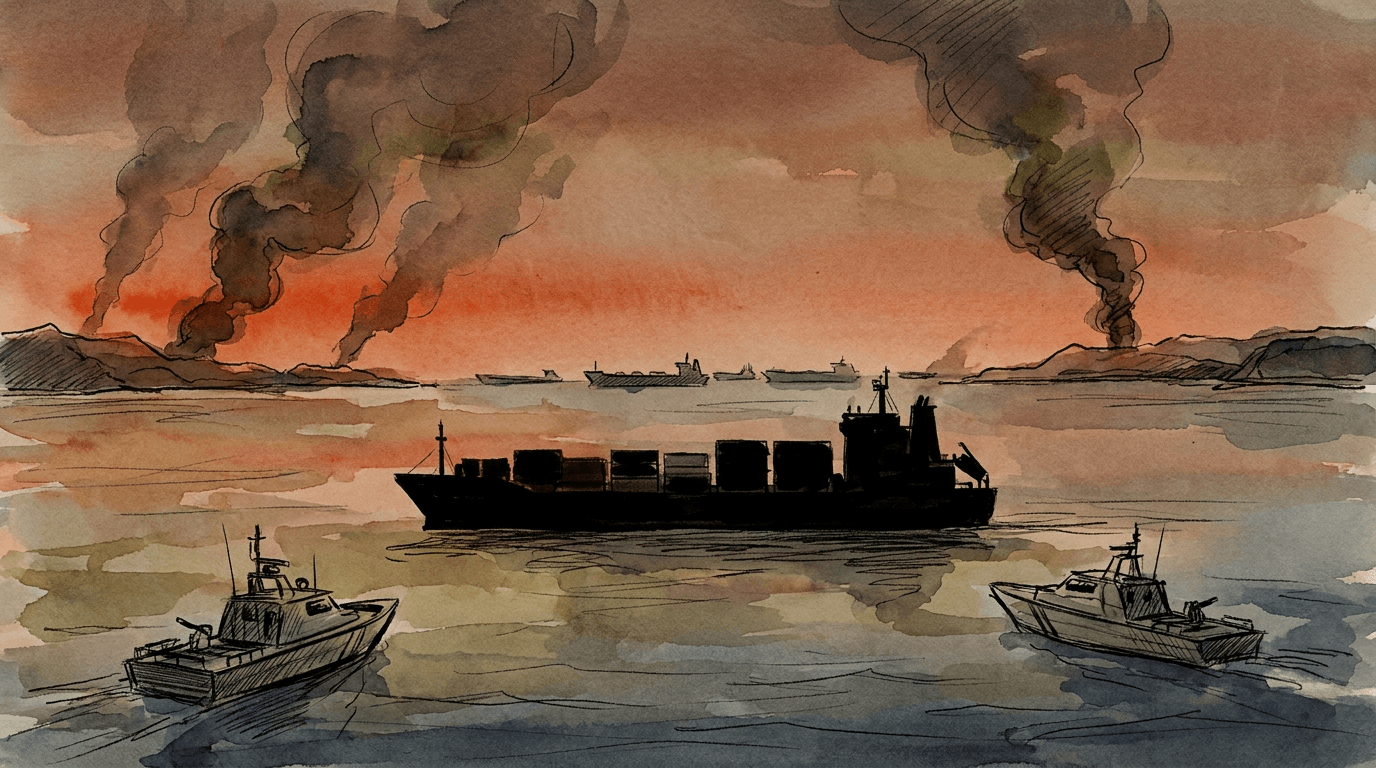
Oil prices surged on July 12, 2026, following fresh military escalation between the United States and Iran around the Strait of Hormuz. WTI crude jumped 4.1% to $74.33 per barrel and Brent rose 3.88% to $78.96 per barrel at 21:15 ET (Eastern Time), per CNBC and Bloomberg.
What we know
The US military—via Central Command (Centcom, the unified headquarters responsible for American military operations in the Middle East, based in Qatar)—launched a fourth round of strikes against Iran on July 12, 2026, within a week. The previous day, 140 Iranian targets had already been struck.
These strikes responded to an attack by the Islamic Revolutionary Guard Corps (IRGC), Iran's paramilitary force answering directly to Iran's Supreme Leader, against a container ship transiting the Strait of Hormuz.
In retaliation, Iran struck US military facilities in Jordan, Kuwait, Bahrain, and Oman the same day, according to Tasnim, an Iranian press agency founded in 2012 and considered semi-official by the Islamic Republic of Iran.
The strait's status: two contradictory positions
Iran declared the closure of the Strait of Hormuz—the seaway connecting the Persian Gulf to the Gulf of Oman—"until further notice." Tehran also demands that ships use a northern route through its territorial waters, asserting control over the passage.
until further notice
— Iran, declaring the Strait of Hormuz closed, July 12, 2026
Central Command formally denied this claim, insisting that traffic continued and the strait remained "open to any vessel wishing to transit legally." Donald Trump echoed this position in an interview broadcast on NBC News's "Meet the Press" on July 12, 2026.
Partial data confirms residual traffic: Windward, a maritime intelligence firm using AI and vessel tracking via AIS data, identified 9 ships transiting the strait on July 11, 2026. The Joint Maritime Information Center (JMIC), a US-led maritime coordination hub based in Bahrain, confirmed that the southern route through Omani waters remained open in both directions, while calling the security situation "severe" and urging mariners to exercise "extreme vigilance."
Energy market reaction
Beyond crude oil, European natural gas added as much as 2.7% during the same session. These gains reflect a broader trend: Brent had already advanced 5.4% in the week leading to July 12, 2026, per Bloomberg, reflecting mounting geopolitical risk premium.
Related articles


Latest articles
The illustrations in this article are generated by artificial intelligence.
Comments
No comments yet. Be the first to react.