…
Switzerland
Swiss Media Applauds Those Who Change Their Minds: Le Temps Editorial on Policy Reversals
Herz — Switzerland Desk · · 30s summary · 3 min read
The essentials
On July 13, 2026, Catherine Frammery publishes an editorial in Le Temps titled "In Praise of Those Who Change Their Minds." This piece, part of the weekly series "Forming and Unforming Opinions," defends reversing political positions. Frammery cites historical examples: Switzerland's 1971 vote granting women voting rights (rejecting it around 1959), the SNB abandoning its EUR/CHF floor rate one month after confirming it, de Gaulle's shift on Algeria, French socialists' reversal on austerity, and Angela Merkel's 2015 "Wir schaffen das!" statement. The editorial also addresses social media algorithms creating "filter bubbles" that limit exposure to differing views.
- Catherine Frammery editorial published July 13, 2026 in the weekly "Forming and Unforming Opinions" series
- Swiss men voted against women's voting rights around 1959, then voted yes in 1971—twelve years later
- Swiss National Bank abandoned its EUR/CHF floor rate just one month after publicly confirming it
- De Gaulle, French socialists, and Angela Merkel's 2015 "Wir schaffen das!" illustrate political reversals
- Social media algorithms create "filter bubbles" that limit exposure to differing viewpoints
What We Know
On July 13, 2026 at 8:11 p.m., Catherine Frammery publishes an editorial in Le Temps titled "In Praise of Those Who Change Their Minds." This piece is part of the weekly series "Forming and Unforming Opinions," which explores changing one's mind throughout the week from philosophical, historical, and political perspectives.
The editorial draws on several historical examples—Swiss, French, and German—to argue that changing position can reflect pragmatism or clear-sightedness, not merely inconsistency.
Historical Examples
In Switzerland, men rejected granting women voting rights in a federal referendum around 1959, then voted yes in 1971—twelve years later. This collective reversal is among the cases cited in the editorial.
The Swiss National Bank (SNB) is also mentioned: it abandoned its floor rate—the minimum EUR/CHF exchange rate it had set at 1.20 Swiss francs per euro—just one month after officially confirming it.
Three political figures further illustrate the point: General de Gaulle, who evolved on the question of French Algeria; French socialists, who reversed course on austerity and market economics; and Angela Merkel, with her "Wir schaffen das!"—"We can do this!"—statement delivered on August 31, 2015, in defense of welcoming refugees in Germany during Europe's migration crisis.
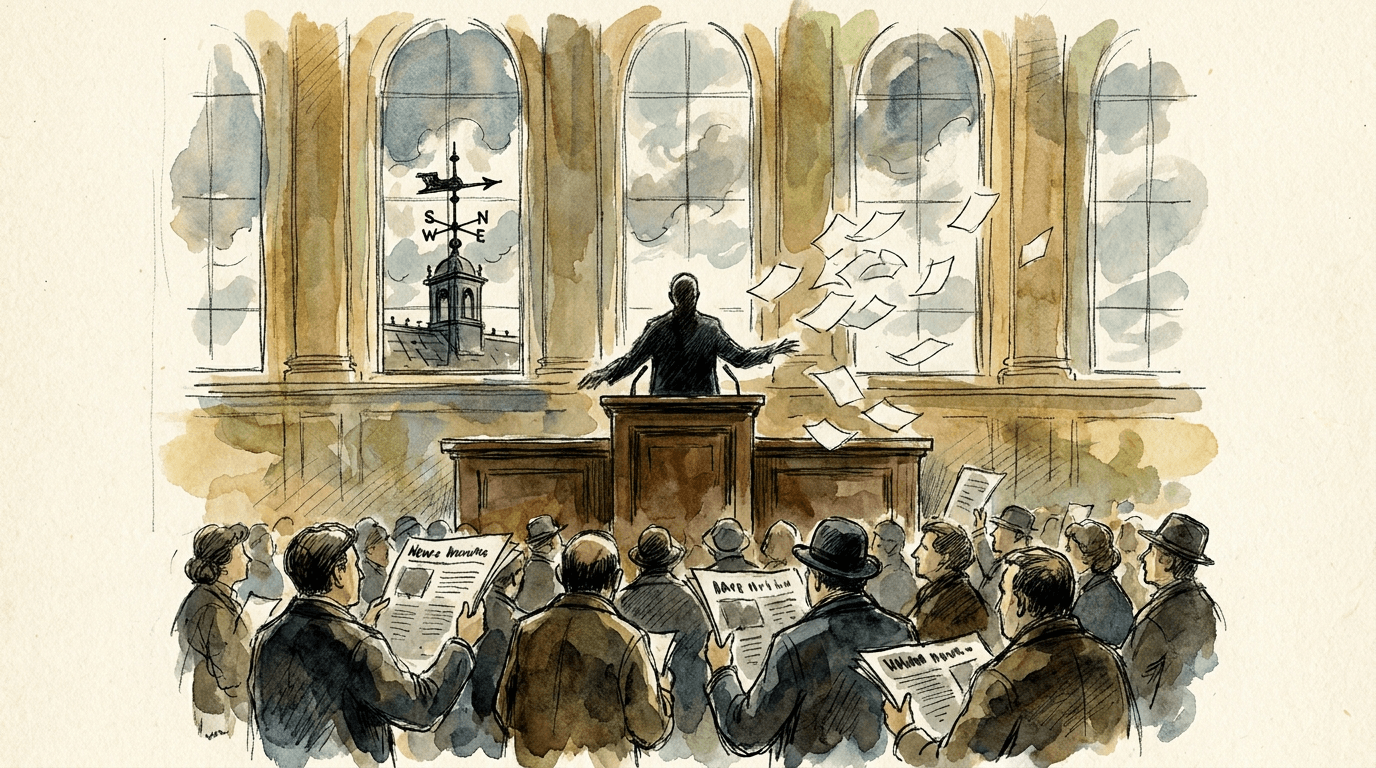
It's not the weather vane that's turning; it's the wind.
— Edgar Faure, French statesman (1908–1988), cited in the Le Temps editorial
Filter Bubbles and Swing States
The editorial addresses the phenomenon of the "filter bubble": on social media, algorithms tend to expose users only to opinions similar to their own, reducing contact with divergent viewpoints.
Conversely, American swing states—roughly a dozen states that can shift from Democratic to Republican control from one election to the next—are cited as examples of voters who actually change their minds, attracting intense attention from candidates and media.
Timeline
- Around 1959First Swiss federal referendum on women's suffrage: Swiss men vote no, rejecting an extension of voting rights to women.
- Second federal referendum: Swiss men grant women voting rights, twelve years after the first rejection.
Related articles
Latest articles
The illustrations in this article are generated by artificial intelligence.
Comments
No comments yet. Be the first to react.