…
Sport
Roman Concrete: Carbonation Strengthened Its Durability, 2026 Study Confirms
Herz — Sport Desk · · 30s summary · 2 min read
The essentials
A 2026 study published in Science Advances establishes that carbonation substantially strengthened Roman concrete. Xiaohong Zhu and colleagues analyzed a slab roughly 1,900 years old recovered from the latrines of Hadrian's Villa near Rome. Calcite, formed by a slow reaction between lime, moisture, and CO₂, filled cracks and pores, making the material denser and more impermeable. This mechanism complements the already-known reaction between volcanic ash and lime. Researchers hope to contribute to the development of modern concrete with similar self-healing properties.
- Carbonation identified as key factor in Roman concrete longevity
- Study analyzes 1,900-year-old slab from Hadrian's Villa latrines near Rome
- Calcite gradually fills cracks and pores, densifying the material
- Volcanic ash also strengthens concrete at rock–lime interfaces
- Researchers aim for modern concrete with similar self-healing properties
What We Know
A 2026 study published in Science Advances by Xiaohong Zhu and colleagues concludes that carbonation substantially strengthened Roman concrete's durability, complementing the already-known reaction between volcanic ash and lime.
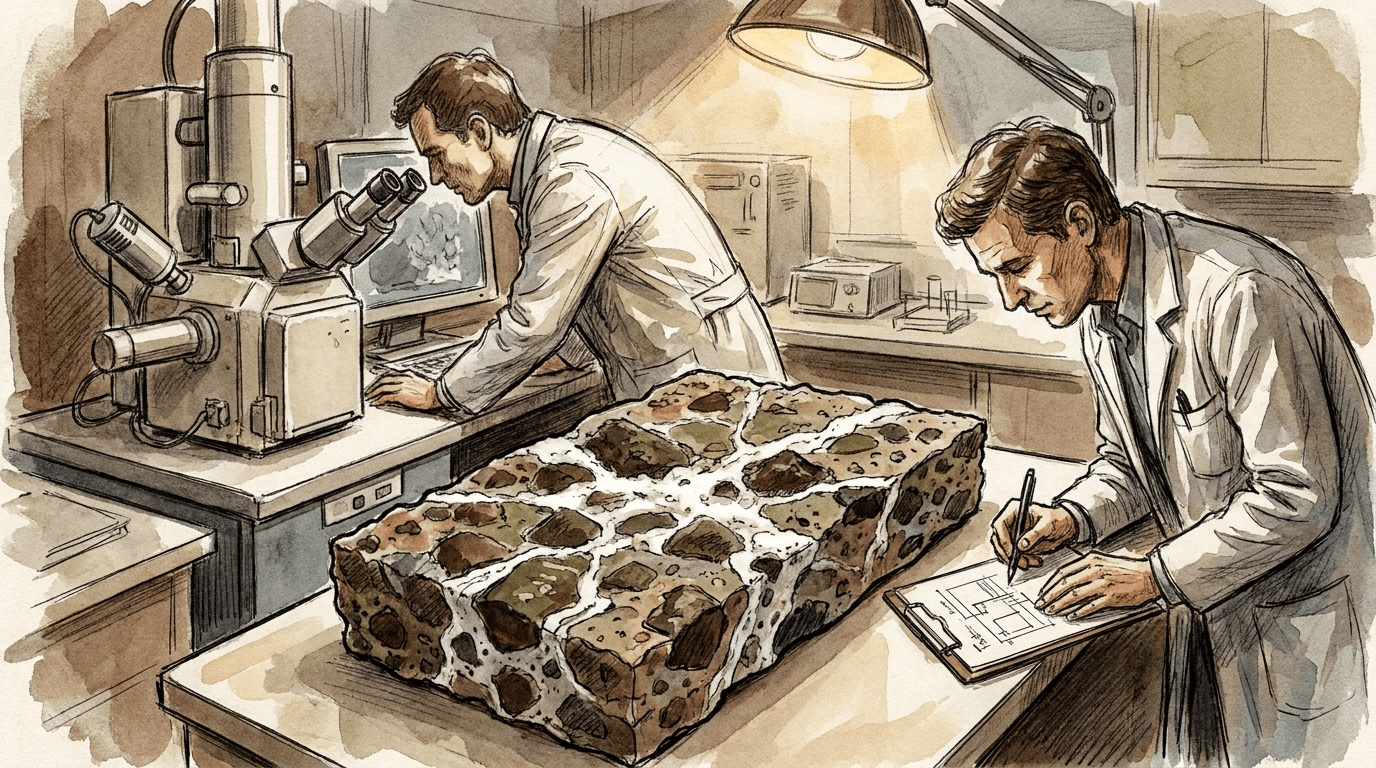
To reach this conclusion, researchers analyzed a concrete slab roughly 1,900 years old recovered from the communal latrine pit of Hadrian's Villa, a resort complex located near Rome. The sample comprised volcanic rock fragments, volcanic ash, and lime.
The team employed 3D X-ray scanners, high-power electron microscopes, and a series of chemical and mineralogical tests. These instruments mapped pores, cracks, volcanic fragments, and mineral crusts across scales ranging from millimeters to nanometers.
The Role of Calcite
Calcite—calcium carbonate formed by a slow reaction between lime, moisture, and atmospheric CO₂, a process called carbonation—is the primary binding mineral in Roman concrete. By gradually filling cracks and pores, it made the concrete denser and more impermeable to degrading agents.
The edges of volcanic fragments also reacted with lime to form small amounts of a cementitious compound, strengthening the material at rock–lime interfaces.
Context: Cumulative Research on Roman Concrete
In 2023, a Massachusetts Institute of Technology (MIT) study proposed that white lime fragments visible in Roman concrete indicated a self-healing capacity: when cracks appeared, water would dissolve these fragments and redeposit minerals filling the gaps.
Prospects for Modern Concrete
Researchers hope their findings will contribute to developing sustainable modern concrete with self-healing properties similar to those observed in Roman structures.
What is concrete carbonation?
Carbonation is a slow chemical reaction between lime in concrete, moisture, and atmospheric CO₂. It produces calcite (calcium carbonate), which gradually fills cracks and pores, making the material denser and more impermeable.
Why analyze concrete from Hadrian's Villa latrines?
Hadrian's Villa near Rome provided a roughly 1,900-year-old slab whose composition—volcanic rocks, ash, and lime—is representative of Roman concrete-making technique. The site's conditions preserved a usable sample for analysis.
How does this differ from the 2023 MIT study?
The 2023 MIT study addressed Roman concrete's self-healing capacity via dissolution of lime fragments when cracks form. The 2026 study identifies carbonation as a distinct strengthening mechanism that enhanced the material over centuries.
Related articles



Latest articles
The illustrations in this article are generated by artificial intelligence.
Comments
No comments yet. Be the first to react.